
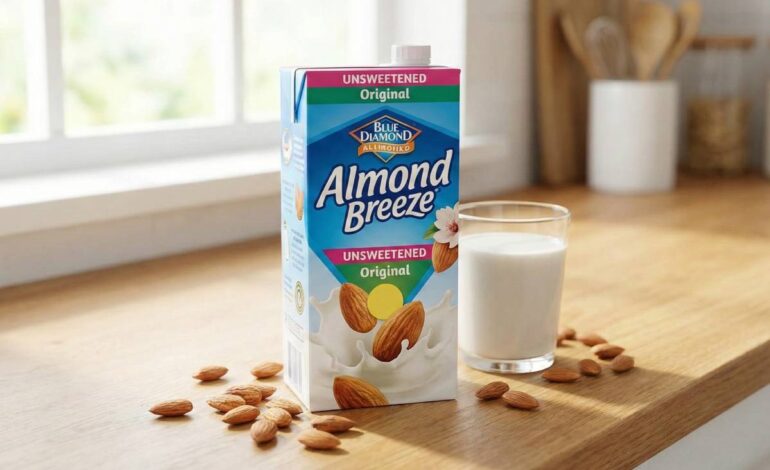
Is Blue Diamond Almond Milk Healthy? An Honest, Evidence-Based Review (2026)

You’re standing in the dairy aisle, staring at a wall of cartons. You reach for the Blue Diamond Almond Breeze; it’s familiar, affordable, and says “50% more calcium” on the box. But then you pause.
Is it actually good for you? Or is it just expensive, cloudy water thickened with gums and additives?
With conflicting advice flooding social media—one influencer praising it as a superfood, another demonising “seed oils” and gums—it’s impossible to know who to trust. You don’t want to drink chemicals, but you also don’t want to spend $8 on a single bottle of artisanal nut milk.
We’ve done the heavy lifting for you. In this deep dive, we strip away the marketing fluff to analyse the ingredient label, the nutritional density, and the potential downsides of blue diamond almond milk so you can decide if it belongs in your cart.
Quick Answer: Is blue diamond almond milk Healthy?
Yes, generally speaking. Blue Diamond Almond Breeze (specifically the Unsweetened variety) is a healthy, low-calorie dairy alternative for most people. It is carrageenan-free and highly fortified, providing significantly more Calcium and Vitamin E than dairy milk.However, it is a processed food. It relies on Gellan Gum for texture and contains relatively few almonds (approx. 2%) compared to premium brands. It is excellent for those seeking a fortified, budget-friendly milk substitute, but less ideal for those seeking a whole-food, additive-free product.
The Label Decoder: What’s Actually Inside?
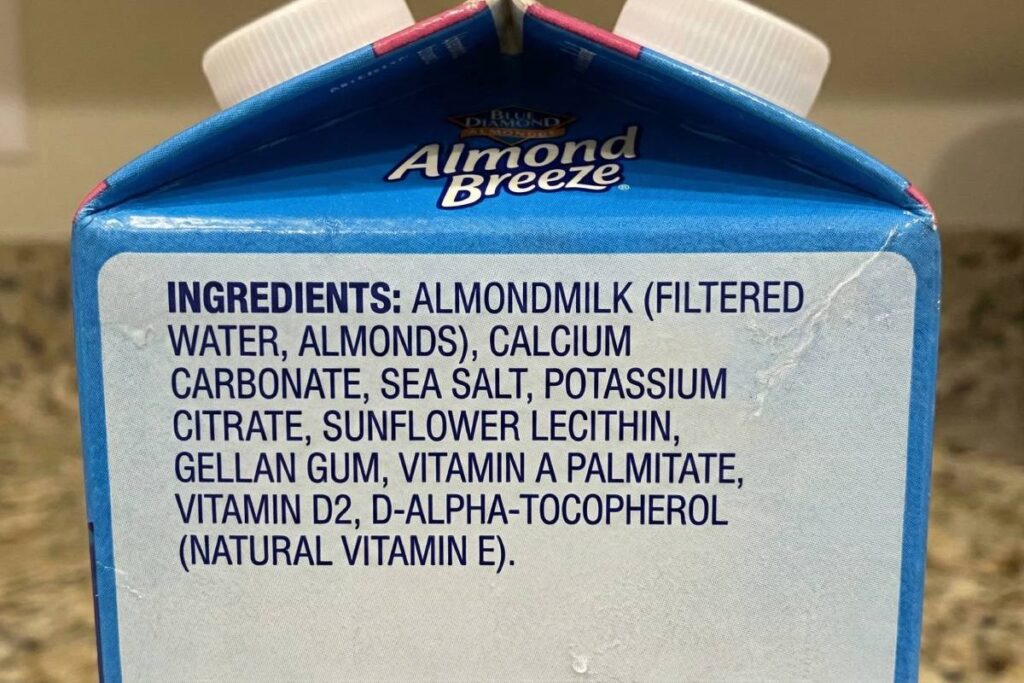
When analysing health, we never look at the front of the box. The truth is always on the back. Let’s decode the ingredient list of the most popular SKU: Blue Diamond Almond Breeze Unsweetened Original.
The Ingredients List:
- Almondmilk (Filtered Water, Almonds)
- Calcium Carbonate
- Sea Salt
- Potassium Citrate
- Sunflower Lecithin
- Gellan Gum
- Vitamin A Palmitate
- Vitamin D2
- D-Alpha-Tocopherol (Natural Vitamin E)
The “Almond Ratio” Reality
Here is the uncomfortable truth about mass-market almond milk: It is mostly water.
Industry estimates suggest that brands like Blue Diamond and Silk contain approximately 2% almonds. The rest is filtered water and emulsifiers. If you are drinking this for the protein found in raw almonds, you are looking in the wrong place (it has only 1g of protein per cup).
However, being water-based isn’t inherently “unhealthy”—it’s what makes the product low-calorie (30 calories/cup).
Nutritional Breakdown vs. Cow’s Milk
Blue Diamond isn’t trying to be almonds; it’s trying to replace milk. So, how does it stack up against 2% dairy milk?
| Nutrient (per 1 cup) | Blue Diamond (Unsweetened) | 2% Dairy Milk | The Winner |
| Calories | 30 | 122 | Blue Diamond (Weight Loss) |
| Carbohydrates | 1g | 12g | Blue Diamond (Keto/Low Carb) |
| Sugar | 0g | 12g (Lactose) | Blue Diamond |
| Protein | 1g | 8g | Dairy Milk (Muscle Building) |
| Calcium | 450mg (45% DV) | 295mg (30% DV) | Blue Diamond (Fortified) |
| Vitamin E | 7.5mg (50% DV) | 0.1mg | Blue Diamond |
| Vitamin D | 2.5mcg (25% DV) | 2.9mcg | Tie |
Key Takeaway:
Blue Diamond is a micronutrient powerhouse but a macronutrient lightweight. It wins on calcium and vitamins but fails on protein.
Expert Insight:
“Don’t rely on almond milk as a protein source for your morning smoothie. If you swap cow’s milk for Blue Diamond, you’re losing 7g of protein. You must add a scoop of protein powder or eat eggs alongside it to maintain muscle mass. For gym-goers, relying solely on almond milk won’t cut it; consider pairing it with a solid protein source or exploring what is pre-workout and is it effective for meeting your performance goals.”
The “Additives” Controversy: Gellan Gum & Natural Flavours
This is where health-conscious consumers usually hesitate. Let’s address the elephant in the room.
1. Gellan Gum (The Texture Agent)
Blue Diamond removed Carrageenan (a controversial thickener linked to gut inflammation) years ago. They replaced it with Gellan Gum.
- What is it? A fermented carbohydrate produced by bacteria.
- Is it safe? Yes. It is considered safe by the FDA and EFSA. In very large doses, it can cause bloating, but the amount in almond milk is negligible.
- Why is it there? Without it, the almond particulate would separate from the water, leaving you with a gritty, watery mess.
2. Potassium Citrate & Sunflower Lecithin
These sound chemical, but they are functional.
- Potassium Citrate: Regulates acidity so the milk doesn’t curdle when you pour it into hot coffee.
- Sunflower Lecithin: An emulsifier that keeps the fat and water mixed. It is generally regarded as healthy and contains choline (good for the brain).
3. “Natural Flavours.”
This is a black box term. While derived from natural sources, it is processed. If you are a strict “whole food” purist, this is a negative mark. For the average consumer, it is not a health risk.
Blue Diamond vs. The Competition
To truly understand value, we must compare Blue Diamond to the other tiers of the market.
Tier 1: The “Clean” Label (Malk / Elmhurst)
- Ingredients: Filtered Water, Almonds, Salt. (No gums).
- Pros: No additives, higher almond content.
- Cons: Expensive ($6-8), separates easily, lower calcium (not fortified).
- Verdict: Better for strict clean eaters, worse for budget and calcium intake.
Tier 2: The Mainstream (Blue Diamond)
- Ingredients: Water, Almonds, Gums, Vitamin Fortification.
- Pros: Fortified (high calcium), creamy texture, affordable ($3-4).
- Cons: Contains gums and flavours.
- Verdict: The best balance of utility and price.
Tier 3: The Generic/Store Brand
- Ingredients: Often similar to Blue Diamond, but may still use Carrageenan or cheap vegetable oils.
- Verdict: Always check the label. Blue Diamond is often superior to generic store brands due to stricter quality control on sourcing.
Final Verdict: Who Should Drink It?
Blue Diamond Almond Milk is a Tier-A processed food. It is not a whole food, but it is a brilliantly engineered vehicle for vitamins and calcium without the calories or lactose of dairy.
Drink this if:
- You are lactose intolerant or vegan.
- You are counting calories (30 cals is unbeatable).
- You need to increase your Calcium intake.
- You want a creamer that won’t split in your coffee.
Avoid this if:
- You have a nut allergy (obviously).
- You are looking for high protein (drink Soy or Pea milk instead).
- You are on a strict “Whole 30” or additive-free diet (stick to Malk or make your own).
Ready to upgrade your nutrition? If you choose Blue Diamond, we recommend sticking to the Unsweetened varieties to avoid unnecessary sugar.
Have you tried swapping dairy for almond milk? Let us know in the comments how the switch affected your digestion, or if it helped with morning fatigue and understanding why it’s hard to get out of bed.